Experts largely discuss over the amount of water you should drink per day, but no one actually knows the reason for such debates.
Many studies suggest that you should drink 8-9 glasses of water per day. But, what happens to your body if you do not drink enough water?
1. There is a great possibility that you will have to deal with a certain health condition. Drinking plenty of water will help you reduce the chances of getting kidney stones, gastrointestinal and urinary tract cancer, and heart attack.
2. The lack of water slows your metabolism. The function of the metabolism depends on the amount of water you drink, so your metabolism will work faster as you increase the water intake, which is one of the basic rules.
3. You will have to put more effort when doing your regular activities. Dehydration pressures and shrinks your brain, and it will need twice as much time to accomplish the tasks.
4. Increased appetite. People who drink 2 glasses of water before their meals eat 75-90 calories less. This routine will help you lose 5 pounds in three months.
5. You look older and your skin is wrinkled. Water hydrates the skin, fills in the fine lines and wrinkles, giving you a nice and bright skin tone.
6. Lack of water causes mood swings. Dehydrated people often feel weak and helpless, confused, angry and depressive, unlike people who drink plenty of water.
reference: Healthy Food House
Brought to you by Nylaan Dental Team - Your Total Health is our goal.
Follow the adventures of my dental team and our experiences in and outside the dental office.
Showing posts with label dental health affects total health. Show all posts
Thursday, October 16, 2014
Thursday, September 25, 2014
Integrated care: healthy mouth, healthy body
In 2013, Cigna published a national study, (1) analyzing its own medical and dental claims among other factors, that highlights an adverse association between untreated periodontal disease and higher medical costs for individuals with diabetes, heart disease, and stroke.
For example, the average annual medical savings for those individuals in the study who had one of these medical conditions but also received appropriate periodontal care was as follows:
- Diabetes: $1,292
- Heart disease: $2,183
- Stroke: $2,831
Findings also indicated a $1,020 average medical savings per person per year for individuals with periodontal disease who received appropriate care, regardless of whether or not they had an underlying medical condition. Why? The study found that individuals who received appropriate preventive dental treatment have, on average, 12.5% fewer extractions and 5.4% fewer root canals. Furthermore, individuals with periodontal disease who are receiving appropriate periodontal care have a 67% lower hospital admission rate and 54% lower ER rate.
Some insights by condition include:
- Diabetes. Individuals with diabetes are more likely to have periodontal disease than people without diabetes, because they are more at risk of getting infections. Inflammation that starts in the mouth may weaken the body’s ability to control blood sugar. The estimated economic cost of diabetes in 2012 was estimated at $245 billion, a 41% increase over a five-year period. More than one in five health-care dollars in the United States is spent caring for someone diagnosed with diabetes. (2)
- Cardiovascular disease or stroke. Periodontal disease and heart disease are often present together. Up to 91% of patients with heart disease have periodontitis, compared to 66% of people with no heart disease. The two conditions have several risk factors in common, such as smoking, unhealthy diet, and excess weight. And some suspect that periodontitis has a direct role in raising the risk for heart disease as well. (3)
- Pregnancy and prematurity. Pregnancy can increase the risk for periodontal disease because of hormonal changes and can worsen existing dental problems. Several studies have shown that periodontal disease may increase the risk for low birth weight and preterm labor. The medical costs that businesses pay to care for one premature baby for a year could cover the costs of 10 healthy, full-term infants ($49,000 vs. $4,550). When combined, maternity and first-year costs for a premature baby were four times as high as those for a baby born without any complications ($64,713 and $15,047, respectively). (4)
As health-care professionals, we can continue to educate patients as to the importance of good oral health and its impact on overall health and even medical costs. Keeping current and thorough medical histories is a key for informing patients of this association.
Armed with research and findings showing the impact of medical/dental integration will help the public understand why going to the dentist is so important.
References
1. Improved Health And Lower Medical Costs: Why Good Dental Care Is Important. Cigna Corporation. 2013.
2. American Diabetes Association by Wenya Yang (The Lewin Group, Inc., Falls Church, Virginia); Timothy M. Dall (IHS Global Inc., Washington, DC); Pragna Halder (The Lewin Group, Inc.); Paul Gallo (IHS Global Inc.); Stacey L. Kowal (IHS Global Inc.); and Paul F. Hogan (The Lewin Group, Inc.). Economic Costs of Diabetes in the U.S. in 2012. Diabetes Care, April 2013;(36).
3. Barker, Joanne. Oral Health: The Mouth-Body Connection. WebMD. Jan. 4, 2012.
4. Thomson Reuters. The Cost of Prematurity and Complicated Deliveries to U.S. Employers. Report prepared for the March of Dimes, Oct. 29, 2008.
Reference: By Miles Hall, DDS; Dental IQ
Thursday, January 30, 2014
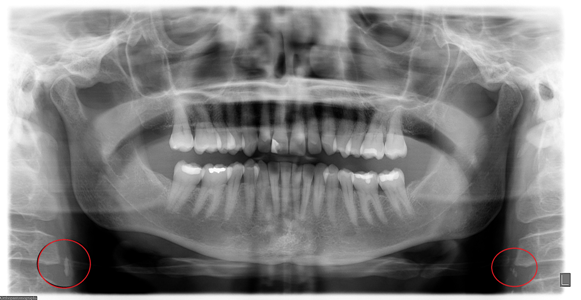
Can a Stroke be prevented by a dental x-ray?
Dentistry is a very serious profession. We learn more everyday as studies show links between the health of the mouth and the health of the mind and body.
Our team recommends a full panoramic film be exposed on every adult every five years. Here is one of the reasons....

Do you see the areas circled in red? See the calcified masses inside those circles? Those are calcification in the Carotid Artery. These type of calcification lead to the occurrence of a Stroke. This patient was referred to her physician. Further testing revealed 50% blockage of her Carotid Arteries. Now she takes medication to reduce her risk of having a stroke, which was in her family history. The satisfying thing for our office was when her physician asked four times "are you sure it was your dentist who sent you here?" Our office goal is to make sure you stay the healthiest as possible in your entire body. Thanks for allowing us the opportunity to help you.
Brian S. Nylaan, D.D.S. and Nylaan Dental Team
Thursday, January 23, 2014
Healthy drinks; other than water
Americans continue to
guzzle extra calories through sugary drinks like soda.
And teens may be among the biggest offenders: Roughly one-third of high school
students in the U.S.
drink two or more sodas, sports drinks, or other sugary beverages per day,
according to the results of a national survey released by the U.S. Centers for
Disease Control and Prevention.
The health dangers of soda are not new. Soda consumption has been linked to an increased risk for heart disease and diabetes, as well as to rising rates of obesity. Recent research from theUniversity of Bangor
and Bristol
suggests that drinking soda can actually trigger sweet cravings by dulling your
sensitivity to sweet tastes, sparking a vicious cycle of eating sweet foods and drinks. “As taste satisfaction levels drop; the more sweet foods are consumed,”
Dr. Hans-Peter Kubis from Bangor University ’s School of Sport ,
Health & Exercise Sciences, who led the study, said in a statement.
Spruce Up Water
Go Natural With Green Tea
Red Wine Is Fine
Drink Your Vegetables!
Schedule your dental evaluation.
reference: everyday health.com; Nylaandental.com
The health dangers of soda are not new. Soda consumption has been linked to an increased risk for heart disease and diabetes, as well as to rising rates of obesity. Recent research from the
Isn’t it about time you and your family kicked the soda habit? Get started with one of these healthier low-calorie thirst-quenchers, sure to still satisfy your taste buds.
Spruce Up Water
Flavored waters have been popping up all over the
place, but many still contain sugar or artificial sweeteners. A healthier
choice is natural flavoring: Just add slices of your favorite fruits and
veggies — lemons, oranges, watermelon, cucumber, mint, or limes — to a pitcher
of ice-cold water for a refreshing and flavorful drink. Another great option is
to put chopped-up fruit in an ice cube tray, add water, and freeze. Place these
colorful fruit cubes in your beverage for instant flavor and color!
Go Natural With Green Tea
Studies of green tea have shown that it may help reduce the
risk of several types of cancer, heart disease, hypertension, kidney stones,
and possibly even cavities. In addition to this, green tea is calorie-free (if
you have it without milk or sugar) and naturally high in antioxidants. You can
pick any flavor you enjoy, because green tea is available in many varieties. It
can be drunk hot or iced, and if you want a little sweetening, a few drops of
honey will serve you well — though most people enjoy it au naturel.
Tonic and Lime…Minus the Gin
Traditionally used as a mixer for alcoholic drinks, tonic has a
distinct taste that makes it such a popular base. But you don't need the
alcohol to enjoy tonic — simply add a few slices of lemon or lime (or both) and
a sprig of fresh mint for a unique and delicious beverage. Many tonic brands
contain high-fructose corn syrup or other sugars, so opt for a diet tonic, if
possible.
Red Wine Is Fine
Red wine , when consumed in moderation, has been
widely reported to reduce the risk for cardiovascular disease. And research on
the benefits of this fermented fruit doesn't stop there — red wine may also
lower your risk of a heart attack, Alzheimer's disease, and even cancer. The
National Institutes of Health recommends that women limit consumption to one
drink per day (4 ounces of wine), and men to two drinks per day, in order to
reap the benefits. Look for wine without additives, such as sulfites, which can
cause headaches and other allergic reactions.
Drink Your Vegetables!
Vegetable juice offers a quick,
low-calorie way to get all the benefits of veggies. It also contains much
less natural sugar than fruit juices. But vegetable juice can be high in
sodium, so opt for a low-sodium version whenever possible. Better yet, make
your own fresh juice easily at home with a juicer. Simply add your favorite
veggies, and even a few slices of fruit if you want to sweeten your drink, to
the juicer — no chopping required! If you prefer a little kick, add some black
pepper and a drop of hot sauce.
We are a dental practice devoted to restoring and enhancing the natural beauty of your smile using conservative, state-of-the-art procedures that will result in beautiful, long lasting smiles!
High Standards
A standard of excellence in personalized dental care enables us to provide the quality dental services our patients deserve. We provide comprehensive treatment planning and use restorative and cosmetic dentistry to achieve your optimal dental health. Should a dental emergency occur, we make every effort to see and care for you as soon as possible.
Education & Prevention
As a practice, we are true believers that preventive care and education are the keys to optimal dental health. We strive to provide “dental health care” vs. “disease care”. That’s why we focus on thorough exams – checking the overall health of your teeth and gums, performing oral cancer exams, and taking x-rays when necessary. We also know that routine cleanings, flossing, sealants, and fluoride are all helpful in preventing dental disease. Not only are we focused on the beauty of your smile, we’re also concerned about your health. A review of your medical history can help us stay informed of your overall health, any new medications, and any illnesses that may impact your dental health.
Thursday, January 2, 2014
Five Healthy Habits and How to Start
We took five goals for better health and found easy ways
to get started right away.
Have a healthy habit (or two) you’d
like to adopt? Most of us do. The tough part is getting started. That’s why
we’ve pulled together these simple but effective tips to help you jump-start
five smart habits–eating breakfast, drinking more water, moving more,
meditating, and getting a better night’s sleep. Choose one to get started.
And when you’re ready, put them all together to give your everyday health an
amazing boost.
Say Yes to Breakfast
The payoff: Eating breakfast fuels your body and brain for a truly good morning.
It also helps jump-start your metabolism, which may be one reason that
breakfast eaters tend to weigh less than those who skip it.
Your best start: Choose foods you’ll look forward to–there are many more choices beyond
plain-old cereal.
Just Add Water
Out and about: When picking up your kids, get out of the car and
greet them with a hug instead of waiting in the car curbside. Park in a remote
corner of parking lots when running errands.
The payoff: Every cell in your body contains water. Staying well hydrated can prevent
headaches, moodiness, loss of focus, and muscle fatigue.
Your best start: Carry a refillable bottle of water with you at all times–in your bag, in
your car, on the job, and at the gym. If it’s handy, you’ll sip it. Also, eat
more fruits and vegetables, which contain lots of water. (Did you know that 91
percent of the weight of broccoli and grapefruit comes from water?)
Boost Your Moves
The payoff: The more you move, the more calories you burn. An active lifestyle can also
improve your mood, appearance, and overall health.
Your best start: Carry a pedometer and make it a game to increase the number of steps you
take each day. Some easy boosts:
At work: Keep a small
water glass that you have to refill often, instead of a large water bottle, on
your desk. Use the stairs, not the elevator. Pace while on the phone.
At home: Put things
away in multiple small trips rather than one big haul. Walk on the treadmill
while watching TV.
Find Your Meditation Match
The payoff: Regular meditation can ease stress, boost memory, and even improve
blood sugar levels.
Your best start: Find the activity that helps you stay in the moment and keeps your mind
focused and clear. That may be watching a flickering candle flame or repeating
a word or mantra. Some people enjoy a walk in the park or a hike in the woods.
Still others find it works to focus on a small morsel, such as a raisin,
strawberry, or nut, and notice its shape, size, color, texture, and scent.
Whatever you choose, try to focus on your breathing and what you are
sensing–seeing, hearing, feeling, tasting, and doing–right now. Let
everything else go.
Sleep Better Tonight
The payoff: Getting a good night’s rest boosts energy and improves immunity.
It’s also been associated with heart health and a longer life span.
Your best start: Create a calming routine. At the end of the workday, write in
a journal or create a to-do list for tomorrow, so you won’t worry
you’ll forget something. A few hours before bed, avoid stressful activities
such as bill paying and watching the news. As you prepare for bed, dim the
lights and quiet any loud noises. Following the same pre-bedtime routine each
night can help you drift off more easily.
Thursday, December 19, 2013
Taking up exercise triples rate of healthy aging
It’s never too late to start exercising to improve your health, even if you’re about to retire, according to a recent study.
People who took up exercise over a four-year period were more than three times as likely to be healthy agers as those who did nothing, according to the study of 3,454 people in
The study, published in the British Journal of Sports Medicine, is one of the first to focus on how exercise affects health in the elderly.
Physical inactivity is the fourth leading risk factor for premature death — after smoking, excessive drinking and obesity — causing an estimated 3.2 million deaths globally, according to the World Health Organization.
“This study supports public health initiatives designed to engage older adults in physical activity, even those who are of advanced age,” the researchers, led by Mark Hamer at University College London, said in the published paper.
Participants, taken from the English Longitudinal Study of Aging, described the frequency and intensity of regular physical activity from 2002 and every subsequent two years until 2011. Any participants with existing chronic disease were excluded.
Healthy aging was measured through absence of major disease and disability, mental health, cognitive abilities and ability to maintain social connections.
The study was funded by the U.S. National Institute on Aging and a consortium of British government departments coordinated by the Office for National Statistics.
Video: how to be as healthy as possible
Reference: Makiko Kitamura
Bloomberg News
Thursday, October 24, 2013
Keep your home healthy
Your dental health affects your overall health and your health and well being is important to our team, so please follow these guidelines:
Keep your home healthy
This time of year, homeowners are shutting
the windows and turning on the furnaces. There are two potentially hazardous
gases that could circulate more freely through your home as a result: carbon
monoxide and radon. Both have the potential to be deadly, but there are things
you can do to protect yourself and your family.
CARBON MONOXIDE
Every year, thousands of people nationwide become ill from carbon monoxide. It is an odorless, colorless and tasteless gas produced by burning fossil fuels, such as natural gas, coal, oil and kerosene. Warning signs of carbon monoxide poisoning include headache, nausea, vomiting, dizziness, drowsiness and confusion. The Michigan Department of Community Health said 934 individuals unintentionally were poisoned by carbon monoxide in 2011, including 22 who died.
The three most common sources of exposure were faulty furnaces or water heaters (23 percent), generators (10.5 percent) and vehicles (10.3 percent).
To protect your family from carbon monoxide, you should follow these steps:
•Never place fuel-powered appliances and equipment, such as generators, washers, saws, welders or compressors, inside your house or garage, where fumes will collect. Always read and follow all of the instructions that come with your equipment. If you are using a generator, use a long extension cord to keep it several feet from the home, away from all open windows, doors and air intakes.
•If you have wood and/ or fuel-powered appliances, have a heating professional clean and inspect them annually and have chimney/vents inspected once a year in the fall. Keep the damper to the fireplace open until the fire is out and the coals are cold.
•Even if the garage door is open, do not leave a car running (this is a safety hazard for several reasons — theft, accidents and carbon monoxide exposure) and, if you have a remote car starter, be careful not to start the car while in an attached garage or near an air intake in your home.
•Consider installing Underwriters Laboratories approved carbon monoxide detectors on every floor of your home or apartment.
Place a detector in or near your bedroom and make sure it has a fresh battery twice a year — or a battery back-up if it plugs into the wall.
If you think you or your family might be suffering from carbon monoxide exposure, get outside immediately and call 911. Health care providers can determine exposure with a blood test. Do not ignore symptoms. You could die within minutes if you do nothing.
RADON
The other danger is radon.
If you live in a home where radon is present, you might be getting high doses of this gas with every indoor breath you take. Radon, similar to carbon monoxide, is colorless, odorless and tasteless, and this radioactive gas can increase your risk of lung cancer. The Surgeon General said radon is the second most frequent cause of lung cancer in theUnited States , just behind
cigarette smoking.
Radon is naturally occurring in rock and soil. It can enter buildings through cracks or openings in the foundation of floors and walls, around sump openings or spaces around plumbing.
It occurs in new and old homes and houses built over a basement, crawlspace or slab. Nearly one in eight homes inMichigan are estimated to have a radon
problem, compared to a national average of one in 15 homes.
The first step is learning if you have radon seeping into your home. The Kent County Health Department recommends testing homes for radon. Just hang a small filter in your home for about one week and mail it for testing in a pre-paid envelope. You will receive the results within a few weeks.
Tests are available at the Kent County Health Department for just $5 each.
For more information, call 616-632-6900.
If the tests show you have radon in your home, the Environmental Protection Agency offers information on how to eliminate this silent killer. Visit epa.gov.
REMINDER
Nov. 3 marks the end of daylight saving time. Be sure to set your clocks back an hour and change the batteries in your carbon monoxide detectors and smoke alarms.
CARBON MONOXIDE
Every year, thousands of people nationwide become ill from carbon monoxide. It is an odorless, colorless and tasteless gas produced by burning fossil fuels, such as natural gas, coal, oil and kerosene. Warning signs of carbon monoxide poisoning include headache, nausea, vomiting, dizziness, drowsiness and confusion. The Michigan Department of Community Health said 934 individuals unintentionally were poisoned by carbon monoxide in 2011, including 22 who died.
The three most common sources of exposure were faulty furnaces or water heaters (23 percent), generators (10.5 percent) and vehicles (10.3 percent).
To protect your family from carbon monoxide, you should follow these steps:
•Never place fuel-powered appliances and equipment, such as generators, washers, saws, welders or compressors, inside your house or garage, where fumes will collect. Always read and follow all of the instructions that come with your equipment. If you are using a generator, use a long extension cord to keep it several feet from the home, away from all open windows, doors and air intakes.
•If you have wood and/ or fuel-powered appliances, have a heating professional clean and inspect them annually and have chimney/vents inspected once a year in the fall. Keep the damper to the fireplace open until the fire is out and the coals are cold.
•Even if the garage door is open, do not leave a car running (this is a safety hazard for several reasons — theft, accidents and carbon monoxide exposure) and, if you have a remote car starter, be careful not to start the car while in an attached garage or near an air intake in your home.
•Consider installing Underwriters Laboratories approved carbon monoxide detectors on every floor of your home or apartment.
Place a detector in or near your bedroom and make sure it has a fresh battery twice a year — or a battery back-up if it plugs into the wall.
If you think you or your family might be suffering from carbon monoxide exposure, get outside immediately and call 911. Health care providers can determine exposure with a blood test. Do not ignore symptoms. You could die within minutes if you do nothing.
RADON
The other danger is radon.
If you live in a home where radon is present, you might be getting high doses of this gas with every indoor breath you take. Radon, similar to carbon monoxide, is colorless, odorless and tasteless, and this radioactive gas can increase your risk of lung cancer. The Surgeon General said radon is the second most frequent cause of lung cancer in the
Radon is naturally occurring in rock and soil. It can enter buildings through cracks or openings in the foundation of floors and walls, around sump openings or spaces around plumbing.
It occurs in new and old homes and houses built over a basement, crawlspace or slab. Nearly one in eight homes in
The first step is learning if you have radon seeping into your home. The Kent County Health Department recommends testing homes for radon. Just hang a small filter in your home for about one week and mail it for testing in a pre-paid envelope. You will receive the results within a few weeks.
Tests are available at the Kent County Health Department for just $5 each.
For more information, call 616-632-6900.
If the tests show you have radon in your home, the Environmental Protection Agency offers information on how to eliminate this silent killer. Visit epa.gov.
REMINDER
Nov. 3 marks the end of daylight saving time. Be sure to set your clocks back an hour and change the batteries in your carbon monoxide detectors and smoke alarms.
reference: The Grand Rapids Press
Thursday, October 3, 2013
10 Ways Your Bad Breath Could Mean Bad Health
Checking your breath may
not just save you from awkward social moments – it may save your life. From
lung cancer to kidney failure, find out what medical conditions doctors can
detect by telling you to just open your mouth.
New findings presented
at the European Respiratory Society (ERS) Annual Congress meeting suggest that
breath tests may be a fast and accurate method for lung cancer screening.
But this isn't the first demonstration that
the breath may hold clues on health. While poor dental hygiene accounts for
most cases of halitosis, bad breath can sometimes be a signal for an underlying medical condition. And even when you take "bad breath" out of the
equation, breath can still demonstrate health issues: a slew of recent studies
have used simple breath tests to screen for medical conditions.
Read on to uncover ways the breath can answer
questions on overall health.
Electric Nose Technology: Detects Lung Cancer from the Breath
Pathologists normally perform biopsies and
ultrasound scans to diagnose lung cancer, but using breath tests may be a
cheaper and non-invasive alternative, according to new findings. Using a
pre-programmed "electronic nose," which detects different profiles of
volatile organic compounds (VOCs) in exhaled breath, researchers from the University of Latvia collected samples of breath
samples from a total of 475 subjects. The subjects included a mix of 252 lung
cancer patients, 223 patients with different lung conditions and healthy
volunteers, 265 smokers, and 210 non-smokers.
They found that among the non-smokers, lung cancer was accurately identified in 128 subjects and misdiagnosed in
only five. Among smokers, the electronic nose correctly identified 114 people
as having lung cancer, misdiagnosing five. The findings were presented on
September 9 in the European Respiratory Society (ERS) Annual Congress in Barcelona .
"Our research has shown us why research
into VOCs is important and how we could use this to understand more about the
way diseases develop and progress," said lead author Maris Bukovskis in a
press release.
Breath Tests Can Detect Heart Failure
Researchers were able
to use a simple breath test to identify patients suffering
from heart failure, according to a March 2013 paper published in the
Journal of the American
College of Cardiology.
Cleveland Clinic researchers collected breath
samples from 41 patients. Twenty five were officially diagnosed with
"acute decompensated heart failure." Sixteen patients had other
cardiovascular conditions but showed no signs of heart failure.
Researchers then used "mass
spectrometry" technology to analyze the breath samples for molecular and
chemical compound signs of heart failure. Within two hours, the breath test
correctly identified the patients with heart failure – while distinguishing
them from the other cardiac patients.
Ashtray Breath
Smoking isn't just bad
for your lungs – it can destroy your dental health by yellowing your teeth and
blackening your lips. Tobacco products can suck the much-needed
saliva out of your mouth, leaving bad breath behind. In addition,
smoking raises the temperature of your mouth, making it a breeding ground for
bacteria.
Fruity or Acetone Breath: A Warning Sign of Diabetes
Poorly managed diabetes can make you more
susceptible to gum disease and dry mouth. When blood sugar levels aren't
stabilized, the weakened body isn't able to fight bacteria that can cause
infections that harm the gums. These same infections can cause bad breath.
But a fruity breath
odor, or an odor similar to acetone (commonly
used in nail polish remover) can also signify a serious complication in diabetic patients called ketoacidosis.
When the body doesn't have enough insulin, it instead uses fatty acids for
energy, which produces acidic ketones, byproducts of fat metabolism. These
acids, which include acetone, hydroxybutyrate, and acetoacetate, can accumulate
in the blood and lead to a diabetic coma and death.
Fish Breath: Kidney Failure
A fishy breath isn't
always from seafood. Mouth that smells fishy, urine-like, or similar to ammonia
may indicate kidney failure.
The kidneys are responsible for removing toxic
chemicals from the blood by creating urine. In kidney failure, also known as
end-stage renal disease, the kidneys become so damaged that they are no longer
able to filter waste products and toxic chemicals from the blood. When this
happens, the dangerous toxins and waste not discharged from the body accumulate
and affect nearly every part of the body. The fishy breath odor can occur when
kidney failure affects the respiratory system and causes breathing problems.
Sleep Conditions May Cause Sour Mouth
Morning breath may seem normal after
a night of slumber. Saliva production decreases during sleep, which gives
odor-producing bacteria an opportunity to multiply and grow.
But the slowed production of saliva during
sleep can sometimes be caused by leaving your mouth open for long periods of
time. People with sleep disorders such as sleep apnea and snoring may have
trouble breathing through the nose, and are more likely to breathe through
their mouths, which increases bad breath.
Excess Weight May Put Your Breath at Risk
Losing the excess weight may also help you
lose the halitosis, according to recent studies. A 2007 study published in the
Journal of Dental Research found a direct link between obesity and bad breath.
After performing clinical check-ups to 88 adults, researchers from Tel Aviv
University found that
overweight patients were more likely to have foul breaths. Researchers suspect
that the diets of overweight people may play a role – diets high in protein and
dairy produce high levels of amino acids, which can encourage the growth of
stinky bacteria. Tel Aviv researchers also linked alcohol to bad breath. Dehydration
may play a role – alcohol is a known diuretic, and a lack of water can trigger
dry mouth. In contrast, drinking ample amounts of water and eating lots of
fruits and vegetables can help keep breath fresh.
Obesity may also emit also odorless fumes in the breath, according to a March
2013 study published in the Journal of Clinical Endocrinology & Metabolism.
Cedars-Sinai Medical Center
researchers analyzed the breaths of 792 men and women, and found that those who
exhaled more methane and more hydrogen had higher body fat percentages and
BMIs.
Digestive Conditions May Distress Your Mouth
Foul breath can mean a
foul gut. Digestive conditions such as acid reflux and gastroesophageal reflux disease (GERD) can manifest in your breath.
Both digestive conditions can delay or prevent food from processing efficiently
from the stomach. When food doesn't move through the digestive system, it can
start to decay. Small amounts of undigested food may even regurgitate and cause
bad breath. Dentists may also detect GERD in patients when they notice an
inflamed red throat and acid erosion in the teeth.
But GERD isn't the
only digestive health issue that can affect your breath. A 2008 study published
in the Journal of Medical Microbiology suggests that the H. pylori bacteria that causes stomach ulcers can make
breath smelly if it lands in the mouth.
Respiratory Infections May Infect Your Breath
Respiratory tract
infections such as the flu, bronchitis, and sinusitis can be the root cause of
bad breath. When respiratory tract infections break down or inflame the tissues
in the respiratory system, this can trigger the production of bacteria-feeding cells and mucus.
Allergies and postnasal drip may also cause
bad breath, since these conditions tend to clog the nose. This nasal congestion
may force you to breathe through your mouth, which can lead to dryness and the
growth of foul breath-causing bacteria.
Poor Dental Health = Poor Breath
When cavities destroy the enamel, food
particles can get deposited in those holes, called dental caries. Since
brushing your teeth can't remove these food deposits, they can eventually get
bacteria, which produces a bad smell.
Gingivitis is another
medical condition that may cause bad breath. When the gum becomes inflamed with
bacteria, it can result in severe pain and funky-smelling discharge.
Schedule your dental evaluation.
Thursday, June 20, 2013
5 Surprising Signs of Dementia
A new study found that
difficulty chewing may signal dementia. But anything from your BMI to your mood
could be a sign that you're developing this progressive loss of cognitive
functioning.
There's growing evidence that small changes in the way you walk, chew, sleep, and feel may be subtle early indicators of dementia.
Dementia is characterized by the progressive loss of
cognitive functioning as brain cells are destroyed. Major symptoms of dementia include personality
changes, memory loss, neglecting to maintain personal hygiene, and trouble with
speaking and socializing. While Alzheimer’s disease is the most common cause,dementia can also be triggered by a stroke, long-term substance abuse,
Parkinson’s disease, severe head injuries, and other health conditions.
But long before you show obvious signs of dementia,
certain changes in your behavior could signal that you may have the condition.
One: Trouble Chewing Hard Foods
The act of biting an into apple
may predict your odds of developing dementia, according to a study published in theJournal of the American Geriatrics Society (JAGS). Researchers at
Karolinska Institutet and Karlstad University in Sweden studied a sample of 577
people aged 77 or older and found that those who had trouble chewing hard food
such as apples had a much higher risk of mental decline. The Swedish
researchers offered one possible explanation: Since chewing is difficult when
you have few or no teeth — which may be the case for some older people — they
chew less, which reduces blood flow to the brain and therefore may put you at
higher risk for dementia.
Dental Implants to replace missing teeth
Two: Slow Walking
Your walking style could predict
your dementia risk, according to a report presented at the 2012 Alzheimer's
Association International Conference. Several studies presented there found a
correlation between walking abnormalities and signs of cognitive decline on
neuropsychological tests. Another study presented at the conference analyzed
the at-home walking behaviors of 19 older subjects using motion-sensor
technology. They found those with a slow pace had smaller brain volumes, which
is often true of people with dementia.
Three: Trouble Sleeping
More bad news for night owls: Your sleep
cycle now may lead to dementia later. In a December 2011 study published in Annals
of Neurology, 1,300 healthy women over the age of 75 were followed
over the course of five years. By the end of that time, 39 percent had
developed some form of mild cognitive impairment or dementia. Researchers found
that women with weaker circadian rhythms(those who performed less physical
activity early in the day) were 80 percent more likely to develop mild
cognitive impairment or dementia than
women who were active early in the day.
Four: Carrying Extra Pounds
Being overweight is linked to
many health dangers — including type 2
diabetes, heart disease, and arthritis. But one study, published in May 2011 in Neurology, linked a high BMI to a higher dementia risk. In an analysis of
8,534 twins aged 65 and older, it was noted that 350 were officially diagnosed
with dementia and 114 with possible dementia. When researchers tracked their
BMIs from 30 years earlier, they found that those with dementia or possible
dementia now were 70 percent more likely to have been overweight or obese back
then.
Worried that your extra weight could lead to cognitive
decline later on? The answer may be to start a workout program. A July study
presented in the Alzheimer's Association International Conference concluded
that exercise may protect the aging brain.
Five: Being Depressed
Feeling blue isn’t only bad for
your emotional well-being — depression can take
a toll on your brain health, too. A study published in the Archives
of General Psychiatry evaluated
the medical records of more than 13,000 California
residents over the course of six years. Those with late-life depression had double the chance of developing Alzheimer’s
disease, while those with both mid- and late-life depression had more
than triple the risk of developing vascular dementia.
reference: Everyday HealthRequest a dental appointment
Thursday, January 31, 2013
More than dental care; we believe in your overall health
We believe that when you come to us, you are trusting us with your health.
For us, health is not only about the mouth it's about your whole body and what is going on in your body. We take time to explore all of this, starting with a blood pressure check and oral cancer screening.
A good number of patients have thanked us for finding undiagnosed hypertension that they then followed up with their primary care physicians. Finding suspicious changes in the mouth, head and neck has also alerted patients to go for further diagnostic testing. Since our patients often see us more than their physicians, we consider it time well used and part of our comprehensive caring.
We believe that you have a right to know what is going on in your body and that teaching involves more than just telling. It would be easier and quicker to just do the exam and tell you what you need. That`s what the great majority of dentist offices do, so anything else feels different. Our process of co-discovery takes more time and involves you in exploring and really understanding what`s going on in your body. That understanding gives you better knowledge for making decisions for your care.
~ Olivia
Subscribe to:
Posts (Atom)