Thursday, February 27, 2014

Yet Another Study Links Soda to Yet Another Health Problem

If there's anything good to say regarding soft drinks and your health, researchers are having a hard time finding it.

Apparently you don’t want protein in your urine, or at least not too much of it. It can make your kidneys very unhappy. (Who knew? Well, kidney doctors, I guess.) Why soda of all things might cause elevated levels of protein in your pee seems to be even more of a mystery, but it’s another incident in the steady drumbeat of science that seems to be saying ever louder: “You’re crazy if you’re still nursing a soda habit.”
More than 12,000 people with normal kidney function participated in a recent study out of Osaka University. Those who drank two or more sodas per day were more likely to have protein in their urine (11 percent), versus those who drank one soda a day (9 percent) or those who didn't drink any (8.4 percent), as HealthDay reports.
This is the amount of sugar in one 20 oz pop.
It is not good for your body or your teeth
This isn't earth-shattering—soda has been linked to kidney disease before. And of course, that’s not the only serious health problem researchers have tied soda to. There’s the elevated risk for heart disease, stroke, certain cancers, and type2 diabetes—health problems that are almost all tied to soda’s pretty-well-documented-but-of-course-the-soda-industry-still-denies-it propensity to make us overweight or obese.
Soda’s also been linked to gout, which always sounds like one of those Dickensian maladies afflicting portly, grouchy barristers who thump coal-smudged orphans with their canes.
“The new study suggests that even individuals with normal kidney function are at risk for damage if they drink too much soda,” one kidney specialist who apparently was not involved in the study tells HealthDay. “There is no safe amount of soda,” he adds. “If you look at the recommended amounts of sugar we can safely consume every day, one can of soda exceeds the maximum level.”
Indeed, while the American Heart Association recommends men not exceed the equivalent of 36 grams of sugar a day and women limit their intake to 24 grams, a 12-ounce can of regular soda can easily contain upwards of 40 grams. 
Kidney issues are the latest health problem to be
 associated with soda consumption. 

But even as the evidence mounts that soda is exacting an outsize tax on public health, the public itself seems to have mixed feelings about taxing soda. Even as New York City’s infamous ban on super size sugary drinks
 remains in legal limbo, San Francisco seems poised to impose a tax on all soda (24 cents per can). Yet voters in Telluride, Colo., soundly rejected a soda tax this month by nearly a two-thirds margin.  
This bit of detail from Politico on the Telluride vote was telling:  In early July—a little over a week after [Elisa Marie Overall, who works at the town medical center] pitched Proposition 2A to the town council—Charlie Sheffield, a lobbyist hired by the Colorado Beverage Association, showed up in Telluride to set up camp and convince the town to vote against the initiative.
"The beverage industry swooped in pretty quickly," recalled Overall, who said she believes Sheffield has been living in Telluride since. "He walked in wearing a suit. No one wears a suit here! Now he wears flannel and Carhartts—and carries a backpack instead of a briefcase."

Meanwhile, south of the border, Mexico has passed a nationwide junk-food tax, which places a levy on soda and other foods—and industry has responded by moving from sugarcane-sweetened Coca-Cola to high-fructose corn syrup.  
Schedule your dental examination to keep
 your teeth, mouth and body healthy!

Tuesday, February 18, 2014

How soda affects your body

Weight 
This is the amount of sugar in a 20 ounce soda.

Drinking one soda a day equates to consuming 39 pounds of sugar per year. Regularly consuming sugary drinks interacts with the genes that affect weight. Sugar-sweetened beverages are linked to more than 150,000 obesity-related deaths a year.

Brain 

Having too much sugar in your diet reduces production of a brain chemical that helps us learn, store memories and process insulin. Consuming too much sugar also dulls the brain's mechanism for telling you to stop eating. 

Kidneys

The high levels of phosphoric acid in colas have been lined to kidney stones and other renal problems. Diet cola is increased with a two-fold risk especially when more than two servings a day are consumed. 

Digestive System

The carbonation in soft drinks can cause gas, cramping, and exacerbate the affects or irritable bowel syndrome. Caffeine can also worsen episodes of diarrhea or contribute to constipation. 

Bones

Soda consumption has been linked to osteoporosis and bone density loss, likely due to the phosphoric acid and caffeine in soda. 

Heart

Chronic diet and regular soda consumption leads to an increase risk of heart disease, including heart attack and stroke. 

Teeth 

The sugar causes tooth decay and the phosphoric acid from soda erodes the enamel of your teeth weakening the structure leading to deeper decay and tooth sensitivity. 

Make your dental appointment before you have a problem!


reference: DIY Natural 

Thursday, February 13, 2014

What is the average cost of keeping a tooth healthy?

Sometimes wonder what the worth is regarding your hygiene appointment?  We have been talking about how we improve your health by keeping the mouth bacteria free so let's see what the dental benefits might be...

Look at the normal sequence of treatment on a typical tooth and you can make an informed choice as to what the importance is of a regular appointment with our hygiene team.

 Healthy Molar
Molar with a small Cavity


Molar with silver fillings (approximately ~ $200)

Molar with larger replacement silver fillings (Approximately ~ $400)

Molar Root Canal Treatment (Approximately ~ $900)


Molar Crown (Approximately ~ $1000)


Molar tooth replaced by a dental implant (Approximately ~ $4000)


Total Average Lifetime Cost Approximately ~ $6000


Total Average Lifetime Cost of a Healthy Tooth Approximately ~ $10 per year

See your dentist regularly to keep all your teeth as healthy as possible. A healthier mouth also leads to a healthier body!


Request an appointment


Thursday, February 6, 2014

7 Things You May Not Know About Cold Sores


You're Contagious Before a Cold Sore Even Appears
The herpes simplex virus (HSV) that causes cold sores is actually activated a day or two before you have any visible symptoms, just as it is with chicken pox and other herpes viruses. So you're contagious a few days before a cold sore appears and until after the sore heals. Some people—about one-third to one-half of those who get cold sores—experience prodromal symptoms a day or two before a cold sore appears, including a slight fever and/or tingling, stinging or itching on the lips. But many do not. Your best protection? Don’t share lipstick, lip balm, a toothbrush, a drinking glass or anything else that comes in contact with your mouth.
Cold Sores on the Lips Can Cause Genital Herpes 
In most cases, genital herpes and cold sores on the lips are caused by two different strains of the herpes virus: HSV-2 and HSV-1, respectively, although genital herpes can also be caused by HSV-1. However, if you have a cold sore on your lip and you engage in oral sex with your partner, you can transfer the HSV-1 virus, giving your partner genital herpes. Genital herpes caused by HSV-1 tends to be less severe and flare-ups tend to occur less frequently than genital herpes caused by HSV-2, but both are lifelong infections. Best advice: Avoid kissing and oral sex whenever you have a cold sore.
You Probably Have the Virus that Causes Cold Sores
As many as 90 percent of people have antibodies to HSV-1 by the time they become adults, meaning they were exposed to the virus at some point in their lives, usually during childhood. They may have been exposed to the virus through close contact with a child who had it or by handling an object that contained the virus, like a toy that had been in the mouth of another child. In many people, the virus remains dormant, never producing any symptoms. About half of those who’ve been exposed to HSV-1 go on to experience actual outbreaks.  ** Our office offers Oral DNA testing and oral HPV virus testing. 
Eating Chicken and Fish May Help Prevent Cold Sores
Chicken and fish are rich in the amino acid lysine, which has been shown to help reduce outbreaks in some people. Other foods that contain lysine include eggs, potatoes and yogurt. Taking supplements of lysine may also help. In one study, doctors at Indiana University found that 88 percent of study participants said lysine supplements were an effective treatment for their herpes infections, with many noting less frequent recurrences and decreased severity of symptoms. Consult your doctor about whether lysine supplementation is right for you.

Dr Nylaan's Waterlase dental laser
You May Be Able to Shorten a Cold Sore Outbreak
You can clear up a cold sore more quickly and help it hurt less by beginning an antiviral medication like valacyclovir (Valtrex) or famciclovir (Famvir) at the first sign of symptoms. Studies show this strategy can make symptoms less severe, shorten the healing time of a cold sore by about two days and, in some cases, even prevent a cold sore from forming. If you know that your cold sores are triggered by a certain factor, such as stress or menstruation, you may be able to take medication a day or two beforehand. Consult your doctor for the best treatment strategy for you. ** Our dental office can reduce your cold sore with our Waterlase soft tissue laser
Try Yoga for Cold Sores
Since stress can be a trigger, try yoga or regular aerobic exercise, deep breathing, guided imagery, meditation and other stress-reducing techniques. This may help minimize the frequency and duration of outbreaks.
An Ice Cube May Relieve Cold Sore Pain
Lidocaine, camphor, menthol and other ingredients found in many nonprescription products do not make cold sores less likely to flare up, but they can soothe the symptoms. So can a simple ice cube. Since different people respond to different ingredients, try a few products to see what works best for you. During flare-ups, avoid foods that are hot, spicy or high in acid, such as orange juice. These may aggravate cold sore symptoms.

Reference: ivillage.com

MOST IMPORTANTLY 

Did you know? 


Our dental office can use our Waterlase dental laser to Relieve the Pain of Cold Sores and Fever Blisters ? 

Waterlase Dentistry often provides immediate relief from painful cold sores and fever blisters. 


We
Schedule your dental appointment today. 

Thursday, January 30, 2014

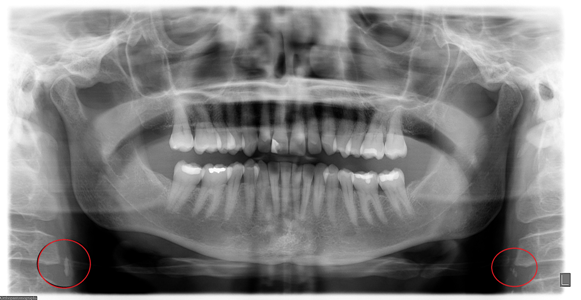
Can a Stroke be prevented by a dental x-ray?

Dentistry is a very serious profession. We learn more everyday as studies show links between the health of the mouth and the health of the mind and body.
Our team recommends a full panoramic film be exposed on every adult every five years. Here is one of the reasons.... 
Do you see the areas circled in red? See the calcified masses inside those circles? Those are calcification in the Carotid Artery. These type of calcification lead to the occurrence of a Stroke. This patient was referred to her physician. Further testing revealed 50% blockage of her Carotid Arteries.  Now she takes medication to reduce her risk of having a stroke, which was in her family history.  The satisfying thing for our office was when her physician asked four times "are you sure it was your dentist who sent you here?"  Our office goal is to make sure you stay the healthiest as possible in your entire body.  Thanks for allowing us the opportunity to help you. 


Thursday, January 23, 2014

Healthy drinks; other than water

Americans continue to guzzle extra calories through sugary drinks like soda. And teens may be among the biggest offenders: Roughly one-third of high school students in the U.S. drink two or more sodas, sports drinks, or other sugary beverages per day, according to the results of a national survey released by the U.S. Centers for Disease Control and Prevention. 


The health dangers of soda are not new. Soda consumption has been linked to an increased risk for heart disease and diabetes, as well as to rising rates of obesity. Recent research from the University of Bangor and Bristol suggests that drinking soda can actually trigger sweet cravings by dulling your sensitivity to sweet tastes, sparking a vicious cycle of eating sweet foods and drinks. “As taste satisfaction levels drop; the more sweet foods are consumed,” Dr. Hans-Peter Kubis from Bangor University’s School of Sport, Health & Exercise Sciences, who led the study, said in a statement.

Isn’t it about time you and your family kicked the soda habit? Get started with one of these healthier low-calorie thirst-quenchers, sure to still satisfy your taste buds.


Spruce Up Water

Flavored waters have been popping up all over the place, but many still contain sugar or artificial sweeteners. A healthier choice is natural flavoring: Just add slices of your favorite fruits and veggies — lemons, oranges, watermelon, cucumber, mint, or limes — to a pitcher of ice-cold water for a refreshing and flavorful drink. Another great option is to put chopped-up fruit in an ice cube tray, add water, and freeze. Place these colorful fruit cubes in your beverage for instant flavor and color!

Go Natural With Green Tea  

Studies of green tea have shown that it may help reduce the risk of several types of cancer, heart disease, hypertension, kidney stones, and possibly even cavities. In addition to this, green tea is calorie-free (if you have it without milk or sugar) and naturally high in antioxidants. You can pick any flavor you enjoy, because green tea is available in many varieties. It can be drunk hot or iced, and if you want a little sweetening, a few drops of honey will serve you well — though most people enjoy it au naturel.

Tonic and Lime…Minus the Gin

Traditionally used as a mixer for alcoholic drinks, tonic has a distinct taste that makes it such a popular base. But you don't need the alcohol to enjoy tonic — simply add a few slices of lemon or lime (or both) and a sprig of fresh mint for a unique and delicious beverage. Many tonic brands contain high-fructose corn syrup or other sugars, so opt for a diet tonic, if possible.

Red Wine Is Fine

Red wine , when consumed in moderation, has been widely reported to reduce the risk for cardiovascular disease. And research on the benefits of this fermented fruit doesn't stop there — red wine may also lower your risk of a heart attack, Alzheimer's disease, and even cancer. The National Institutes of Health recommends that women limit consumption to one drink per day (4 ounces of wine), and men to two drinks per day, in order to reap the benefits. Look for wine without additives, such as sulfites, which can cause headaches and other allergic reactions.

Drink Your Vegetables!

Vegetable juice offers a quick, low-calorie way to get all the benefits of veggies. It also contains much less natural sugar than fruit juices. But vegetable juice can be high in sodium, so opt for a low-sodium version whenever possible. Better yet, make your own fresh juice easily at home with a juicer. Simply add your favorite veggies, and even a few slices of fruit if you want to sweeten your drink, to the juicer — no chopping required! If you prefer a little kick, add some black pepper and a drop of hot sauce.

We are a dental practice devoted to restoring and enhancing the natural beauty of your smile using conservative, state-of-the-art procedures that will result in beautiful, long lasting smiles!
High Standards
A standard of excellence in personalized dental care enables us to provide the quality dental services our patients deserve.  We provide comprehensive treatment planning and use restorative and cosmetic dentistry to achieve your optimal dental health.  Should a dental emergency occur, we make every effort to see and care for you as soon as possible.
Education & Prevention
As a practice, we are true believers that preventive care and education are the keys to optimal dental health.  We strive to provide “dental health care” vs. “disease care”.  That’s why we focus on thorough exams – checking the overall health of your teeth and gums, performing oral cancer exams, and taking x-rays when necessary.  We also know that routine cleanings, flossing, sealants, and fluoride are all helpful in preventing dental disease.  Not only are we focused on the beauty of your smile, we’re also concerned about your health.  A review of your medical history can help us stay informed of your overall health, any new medications, and any illnesses that may impact your dental health.


reference: everyday health.com; Nylaandental.com

Thursday, January 16, 2014

10 Myths and Facts about Water

We all need water to live, but how much do we really know about it? From the truth about drinking eight glasses of water per day to refilling plastic bottles, here's what you should know about water benefits.


For something so seemingly simple and essential as drinking water, plenty of myths and misconceptions exist about possible water benefits and harms.
Learn how to separate the myths from the facts about drinking water.
1. Everyone needs to drink eight glasses of water a day. 

Myth. Though water is the easiest and most economical fluid to keep you hydrated, the latest Institute of Medicine recommendation is that women should strive for about two liters or eight glasses a day and men should aim for three liters or 12 glasses a day of any fluid, not just water. “No one can figure out where this ‘eight glasses of water’ came from, but I believe it came from the old RDA [recommended daily allowance] for water that matched water requirements to calorie requirements,” notes Georgia Chavent, MS, RD, director of the Nutrition and Dietetics Program at the University of New Haven in West Haven, Conn. “The new requirement from the Institute of Medicine is much more generous and includes recommendations for total beverage consumption, not just water.”
2. Drinking water flushes toxins from your body.
Fact. Though water doesn’t necessarily neutralize toxins, the kidneys do use water to get rid of certain waste products. If you don’t drink enough water, your kidneys don’t have the amount of fluid they need to do their job properly. “If the body does not have sufficient water, then metabolic wastes will not be removed as efficiently as they should,” explains Amy Hess-Fischl, RD, CDE, of the University of Chicago Kovler Diabetes Center. “In essence, the body would be holding in toxins instead of expelling them, as is required for proper health.”
3. Bottled water can cause tooth decay.
Myth. Bottled water in and of itself doesn’t cause the teeth to decay, but it usually doesn’t contain any fluoride, which is added to tap water to help prevent tooth decay. “Fluoride is an important element in the mineralization of bone and teeth,” says Constance Brown-Riggs, RD, CDE, author of The African American Guide To Living Well With Diabetes and a nutritionist and certified diabetes educator in New York City. “With the increased consumption of bottled water, which is not fluoridated, there has been an increase in dental caries [cavities].”  

4. Drinking water can help keep your skin moist.
Myth. While it used to be believed that staying properly hydrated led to youthful, vibrant skin, the reality is that the amount of water you drink probably has very little to do with what your skin looks like. “Unless the individual is severely dehydrated, drinking large quantities of water will not prevent dry skin,” Hess-Fischl says. “Basically, the moisture level of skin is not determined by internal factors. Instead, external factors such as skin cleansing, the environment, the number of oil glands, and the functioning of these oil-producing glands determine how dry the skin is or will become. The water that is consumed internally will not reach the epidermis [the top layer of the skin].”
5. Drinking water helps you lose weight.
Fact. Drinking water won’t specifically trigger weight loss, but it can aid in the process. Water replaces other calorie-laden beverages in the diet, causing you to reduce your overall number of calories. Plus, it can make you feel fuller, so you may eat less at each meal. Water, particularly cold water, may even play a role in increasing your metabolism. “A new study seems to indicate that drinking water actually speeds up weight loss,” says Tanya Zuckerbrot, MS, RD, owner of Tanya Zuckerbrot Nutrition, LLC, in New York City. “Researchers in Germany found that subjects of the study increased their metabolic rates [or the rate at which calories are burned] by 30 percent after drinking approximately 17 ounces of water.”
6. Yellow urine is a sign of dehydration.
Myth. It can be, but not all yellow urine is cause for alarm. “Dark yellow urine may be a sign of dehydration,” says Zuckerbrot. “The kidneys filter waste products and reabsorb water and other useful substances from the blood, so they control the volume and concentration of urine output. Dehydration leads to increased urine concentration, turning your urine dark yellow. Ideally your urine should be straw yellow in color.” Other factors, though, such as taking a multivitamin, can also lead to yellow urine.
7. If you’re thirsty, you are already dehydrated.
Myth. If you start to feel thirsty, then you are headed in the wrong direction and should grab a drink of water, but thirst doesn’t necessarily mean you’re dehydrated. “Thirst begins when the concentration of [substances in the] blood has risen by less than 2 percent, whereas most experts would define dehydration as beginning when that concentration has risen by at least 5 percent,” notes Hess-Fischl.
8. You need sports drinks, not water, to function at a high level in athletics.
Myth. Sports drinks may have fancier advertising campaigns, but water is really all you need to get the fluid necessary to participate in most athletic endeavors. “Adequate fluid, especially water, is most important for athletes of all ages as it is the single most important way the body has to transport nutrients and energy and remove heat during exercise,” says Chavent. “A sports or vitamin beverage may taste better, but is not necessary for hydration and is expensive.” Keep in mind though that people who run marathons or compete in highly strenuous activites may need to supplement their water intake with sports drinks to offset the salt they lose due to heavy sweating over long periods of time. This doesn’t apply to most people who are simply exercising to get fit at the gym, for instance.
9. It’s possible to drink too much water.
Fact. People with certain health conditions can put themselves at risk of complications if they drink too much water. “People with some heart conditions, high blood pressure, or swelling of the lower legs [edema] need to avoid excess water,” says Hess-Fischl. “If you have a history of kidney problems, especially if you have had a transplant, consult your doctor before increasing your fluid intake.” Hess-Fischl adds that you shouldn't drink too much water while eating, as it dilutes your stomach acid and can cause digestion problems.
10. You should not reuse plastic water bottles. 

Fact. Plastic water bottles can present a couple of risks to people who drink their contents and then fill them up time and again. “These bottles leach chemicals into your water after multiple uses,” Hess-Fischl explains. “The bottle, if not properly cleaned, may also harbor bacteria from your mouth.”
Water is essential to survival — use these facts to figure out if you need to increase your intake or feel reassured that you’re drinking enough.  

Reference:
Medically reviewed by Niya Jones MD, MPH

Links: Brian S. Nylaan, D.D.S.